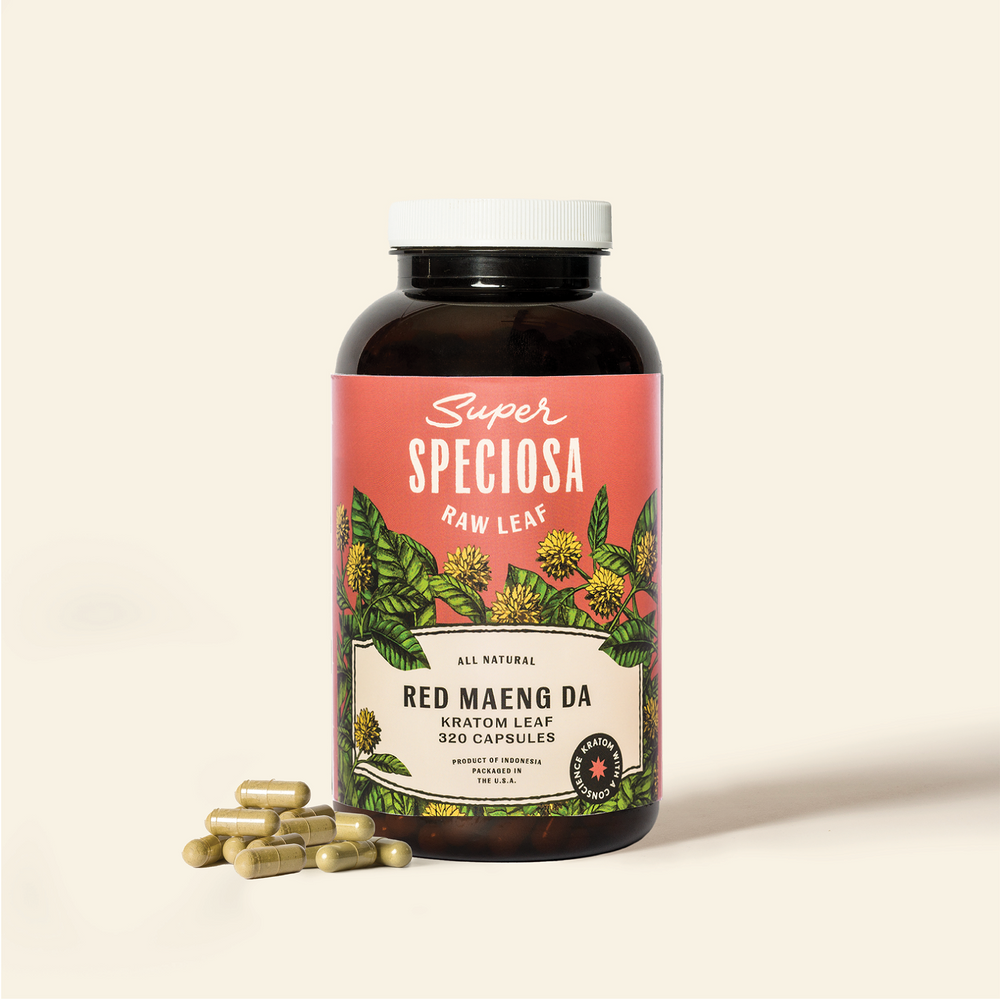
Types of Kratom Explained: Strain Chart, Vein Colors, & How To Choose
TYPES OF KRATOM EXPLAINED: STRAIN CHART, VEIN COLORS, & HOW TO CHOOSE

There are three main types of kratom, sold by vein color: red, green and white. Names like Maeng Da, Bali, Borneo and Thai sit on top of that color as a trade or grade label, and yellow or gold usually means extra processing. Every type comes from one tree, Mitragyna speciosa. What actually separates two bags is how the leaf was dried and how much mitragynine it contains.
Key takeaways:
- All kratom “strains” come from a single species. The labels describe drying, trade names and grade, not different plants.
- Red, green and white describe how the leaf was dried and processed. Leaf maturity isn’t the reason.
- Mitragynine percentage is the most useful number on the bag. Our grades run from 1.0% to 1.5% and up.
- Some popular names, like Green Vietnam, are style labels. Kratom is illegal in Vietnam.
- New to kratom? Start with a green, compare colors with a sampler, and check the batch lab report.
What are the different types of kratom?
Kratom is a tree in the coffee family (Rubiaceae) native to Southeast Asia. It can grow 4 to 16 meters tall, according to the EU Drugs Agency’s kratom profile, and its leaves carry more than 40 related alkaloids. Mitragynine is the main one; see our explainer on what mitragynine is.
So why do shops list dozens of kratom types? Because each bag carries up to three separate labels stacked together. Knowing which is which clears up most of the confusion.
|
Naming layer |
Examples |
What it tells you |
What it doesn’t |
|---|---|---|---|
|
Vein color |
Red, green, white |
How the leaf was dried and processed |
That it came from a different tree |
|
Trade name |
Bali, Borneo, Thai, Malay |
A style the vendor associates with that name |
Where the leaf grew (most US kratom is Indonesian) |
|
Grade name |
Maeng Da, Signature Reserve |
An alkaloid tier set by the vendor |
Anything standardized across brands |
|
Processing label |
Yellow, gold, enhanced |
Extra drying, fermenting, blending or added extract |
A true vein color |
Our own leaf, whatever the name on the label, comes from farmers in Indonesia. West Kalimantan alone has an estimated 112,000 people growing, harvesting and processing kratom, per the Transnational Institute. You can read more about where kratom comes from and how long it takes to grow kratom.
Kratom vein colors explained
You’ll often hear that red kratom comes from mature leaves and white from young ones. That’s a myth, and some older pages on the internet (ours included, which we’re updating) still repeat it. The color of the finished powder mostly comes from drying and processing.
The science backs that up. A University of Florida team found that withering and drying conditions changed the alkaloid profile, raising mitragynine by 14% to 65% in one cultivar, while low drying temperatures preserved it. A 2023 study of 611 Thai leaf samples found that geography changed mitragynine levels but didn’t affect vein color.
Red kratom
Red kratom is dried longer, often with more sun exposure, which darkens the leaf. It’s commonly associated with a calm, easygoing feel, and many customers reach for it in the evening. Our red kratom strains guide covers every red we make, and you can shop the red kratom collection.
Green kratom
Green kratom gets a shorter, gentler dry. People describe it as the middle ground, associated with balanced, all-day energy. That’s why we suggest it for first-timers. See our green kratom guide, the basics of what green kratom is, or the green kratom collection.
White kratom
White kratom is typically dried indoors, out of direct light. It has a reputation for a brighter, more alert feel and is a common morning pick. Start with our white kratom strains guide or browse white kratom.
Yellow and gold kratom
Yellow and gold aren’t vein colors. They’re processing or blend labels, usually from extra drying, fermenting or mixing colors. We explain the details in our pages on yellow kratom and gold kratom.
For head-to-head comparisons, read red vs green kratom, red vs white kratom and green vs white kratom.
Kratom strain chart
This chart covers every single-color kratom we make, graded by guaranteed minimum mitragynine. The “commonly associated with” column reflects customer reports and product reputation, not guaranteed outcomes. Individual experiences vary.
|
Strain |
Vein |
What the name means |
Mitragynine (min.) |
Commonly associated with |
Typical time of day |
|---|---|---|---|---|---|
|
Red |
Trade name; smooth, mild style |
1.0% |
Calm, easygoing |
Evening |
|
|
Red |
Trade name for Indonesian red |
1.0% |
Calm, steady |
Evening |
|
|
Red |
Higher-grade red |
1.3% |
Fuller, stronger red |
Afternoon or evening |
|
|
Red |
Limited, 100% sun-dried batch |
1.0% |
Deep, relaxed |
Evening |
|
|
Green |
Trade name; long-lasting style |
1.0% |
Balanced, all-day |
Midday |
|
|
Green |
Trade name; gentle style |
1.0% |
Mild, balanced |
Any time |
|
|
Green |
Higher-grade green; our best-seller since 2016 |
1.3% |
Focused energy |
Morning or midday |
|
|
White |
Trade name; bright style |
1.0% |
Alert, upbeat |
Morning |
|
|
White |
Higher-grade white |
1.3% |
Strong, energetic |
Morning |
|
|
Varies |
Our top leaf grade |
1.5% |
Our strongest plain leaf |
Varies |
Want the story behind the names? Read about Maeng Da kratom strains, what the colors of Maeng Da mean, what Bali kratom is, Thai kratom vs Maeng Da, Red Bali vs Maeng Da and why Super Red is here to stay.
Why mitragynine percentage matters more than the strain name
Here’s the part most strain charts skip. Two bags with the same name can hold very different amounts of alkaloids, and two bags with different names can be nearly identical.
Researchers see this every time they test the market. A University of North Carolina Greensboro team found commercial kratom products shared a similar alkaloid profile, while the levels of individual alkaloids varied from product to product. In Thai field samples, mitragynine ranged from 0.75% to 2.66% of dry leaf weight, depending on light, humidity and soil.
That’s why we grade every batch by mitragynine and print the grade on the label. The math is simple:
|
Grade |
Mitragynine in 1 g |
Mitragynine in a 2.5 g serving |
|---|---|---|
|
1.0% (Bali, Borneo, Malay, Thai) |
10 mg |
25 mg |
|
1.3% (Maeng Da, all colors) |
13 mg |
32.5 mg |
|
1.5% (Signature Reserve) |
15 mg |
37.5 mg |
A 1.5% powder delivers half again as much mitragynine per gram as a 1.0% powder. Our most potent kratom guide goes further, and our serving size guide shows how much to start with. Every bag has a QR code that opens that batch’s lab report, or you can search any batch in our lab results lookup. Here’s how our batch lookup works and how to read our labels.
How to choose a type of kratom
- Pick your time of day. Morning points toward white, midday toward green, and evening toward red. Our kratom vs caffeine guide helps if you’re swapping out a coffee.
- Start with green if you’re new. Green Malay or Green Bali at the 1.0% grade is the gentlest entry point. Our beginner’s tips cover the rest.
- Check the mitragynine grade. Move up to a Maeng Da (1.3%) or Signature Reserve (1.5%) only once you know how a 1.0% leaf feels.
- Compare colors side by side. Our Powder Flight includes 20 g each of five strains for $19. Prefer capsules? The Kratom Capsule Strain Flight covers eight.
- Choose a format. Powder, capsules and tablets all use the same leaf. See powder vs capsules and powder vs leaf.
- Verify the batch. A named strain with no lab report tells you very little. Our checklist for vetting a kratom vendor lists what to ask for.
- Give each type a fair trial. Allow time for it to kick in (here’s how long kratom takes to work) before judging a new color.
Still deciding? Browse our best kratom strains roundup, our top strains for energy and focus, or the full Maeng Da collection.
Can you mix kratom strains?
Yes. Many people blend two colors, like a green and a white for mornings, or rotate between colors through the week. Rotating also comes up in conversations about kratom tolerance. Just count the combined serving size, not each strain separately. And store open bags well so they keep their quality; here’s how to store kratom.
Types of kratom FAQ
How many types of kratom are there?
There are three main types, named by vein color: red, green and white. Yellow and gold are processing or blend labels. Vendors then add trade names (Bali, Borneo, Malay, Thai) and grade names (Maeng Da, Reserve), which is how you end up with dozens of “strains” from one species.
Are kratom strains different plants?
No. Nearly all commercial kratom is Mitragyna speciosa. Strain names describe drying, processing, a trade style or a grade. Growing conditions and drying change alkaloid levels, which is why lab-tested mitragynine percentage tells you more than the name.
What do kratom vein colors mean?
Vein color mostly reflects how the leaf was dried and processed. Red is dried longest, often in the sun. Green gets a shorter, gentler dry. White is usually dried indoors. Customers commonly associate red with evenings, green with balance and white with mornings.
What is the strongest type of kratom?
Strength follows mitragynine content, not color. In our lineup, Signature Reserve is graded at 1.5% or higher, and Maeng Da in all three colors is graded at 1.3% or higher. Bali, Borneo, Malay and Thai are graded at 1.0% or higher.
Which type of kratom is associated with energy?
White and green kratom are the colors most often associated with energy and focus. White Maeng Da and Green Maeng Da are popular morning choices, while Green Malay has a reputation for steadier, all-day energy.
Is Green Vietnam kratom from Vietnam?
Almost never. Kratom is illegal in Vietnam, so “Green Vietnam” is a style label, typically applied to Indonesian leaf. If you like that profile, Green Malay or Green Maeng Da is the closest match in our lineup.
What’s the difference between yellow and gold kratom?
Both are processing labels rather than vein colors. Vendors use them for leaf that’s been dried longer, lightly fermented or blended from different colors. Recipes vary by vendor, so check the batch lab report for mitragynine content.
Sources
- EU Drugs Agency. Kratom drug profile.
- Zhang M, et al. Alkaloid biosynthesis in kratom varies with postharvest, genetic, and seasonal factors. Frontiers in Plant Science, 2025.
- Sengnon N, et al. Seasonal and geographic variation in alkaloid content of kratom from Thailand. Plants, 2023.
- Leksungnoen N, et al. Variations in mitragynine content in the naturally growing kratom population of Thailand. Frontiers in Plant Science, 2022.
- Manwill PK, et al. Kratom validation: quantitative analysis of indole and oxindole alkaloids. Planta Medica, 2022.
- Transnational Institute. Kratom: the creation of a threat, 2021, and Kratom in Myanmar and Southeast Asia, 2021.
- National Institute on Drug Abuse. Kratom.
This content is for educational purposes only and isn’t medical advice. Kratom products are for adults 21 and older.